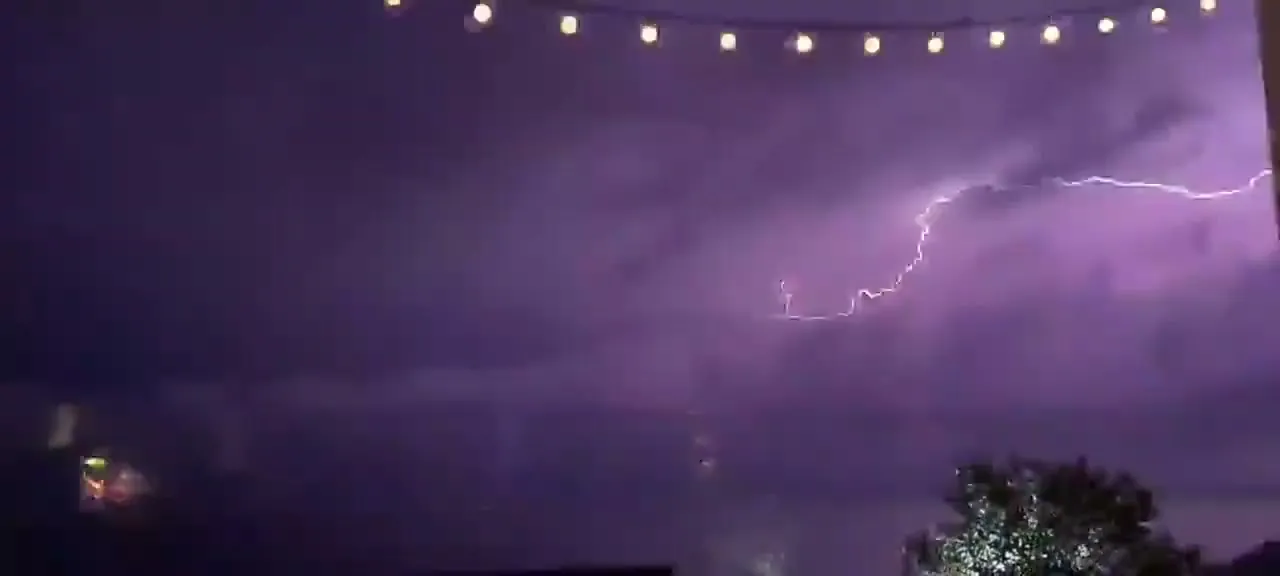
There is a specific kind of evening — warm air, the smell of rain that hasn't arrived yet, an unusual stillness — where you stop whatever you're doing and go stand outside. That's where this clip comes from.
The habit
I've been filming thunderstorms for years. Not systematically — no tripod, no planning, no dedicated setup. Just a phone pointed at the sky when something is happening. The footage is inconsistent, grainy, often out of focus, and I keep every single clip.
What draws me to it is partly the same thing that draws most people: the scale of it, the unpredictability, the way a lightning strike feels both instantaneous and suspended. But there's also something more specific. I build real-time environments for a living, and a thunderstorm is one of the hardest things to get right.
From observation to simulation
I've built real-time thunderstorm systems in Unreal Engine — volumetric clouds, dynamic lightning, the way light from a strike ripples across a wet surface for a fraction of a second before it's gone. Getting that right requires understanding what "right" actually looks like, which means watching a lot of storms very carefully.
The footage helps. Not as reference in the formal sense — you can't pause a real thunderstorm to study the falloff of a flash — but as a way of building intuition. How the sky darkens unevenly. Where the ambient light comes from when there's no direct source. The way string lights, like the ones in this clip, create a kind of baseline brightness that makes the darkness between flashes feel more absolute.
What makes storms hard to simulate
Real-time weather is a problem of timing and variance. Lightning in film can be carefully choreographed. Lightning in a game engine has to feel random while also being legible — players need to sense that a storm is happening without the flashes becoming either wallpaper or a seizure risk. The statistical distribution of strikes, the delay between flash and thunder, the way intensity builds and drops: these are all decisions that have to feel like non-decisions.
Watching real storms — even imperfectly recorded ones on a phone — gives you a ground truth to work from. You start to notice that real lightning is never quite what the default Unreal parameters produce. The duration is shorter. The falloff is faster. The secondary illumination is more diffuse than you'd expect.
The system
Here's what years of filming storms eventually produced: a real-time thunderstorm system built in Unreal Engine. Volumetric clouds, dynamic lightning with physically plausible falloff, rain, wet surfaces, the whole thing running in real time.
The brief for this was straightforward and nearly impossible: it has to feel real. Not photorealistic in the render-farm sense — real in the sense that someone who has watched a lot of actual storms doesn't find it unconvincing. That's a harder target, because the reference is visceral rather than technical.
So I keep filming. The clips are short and badly lit and wouldn't impress anyone. But they're mine, and they go into the work eventually, in ways that are hard to trace but are definitely there.