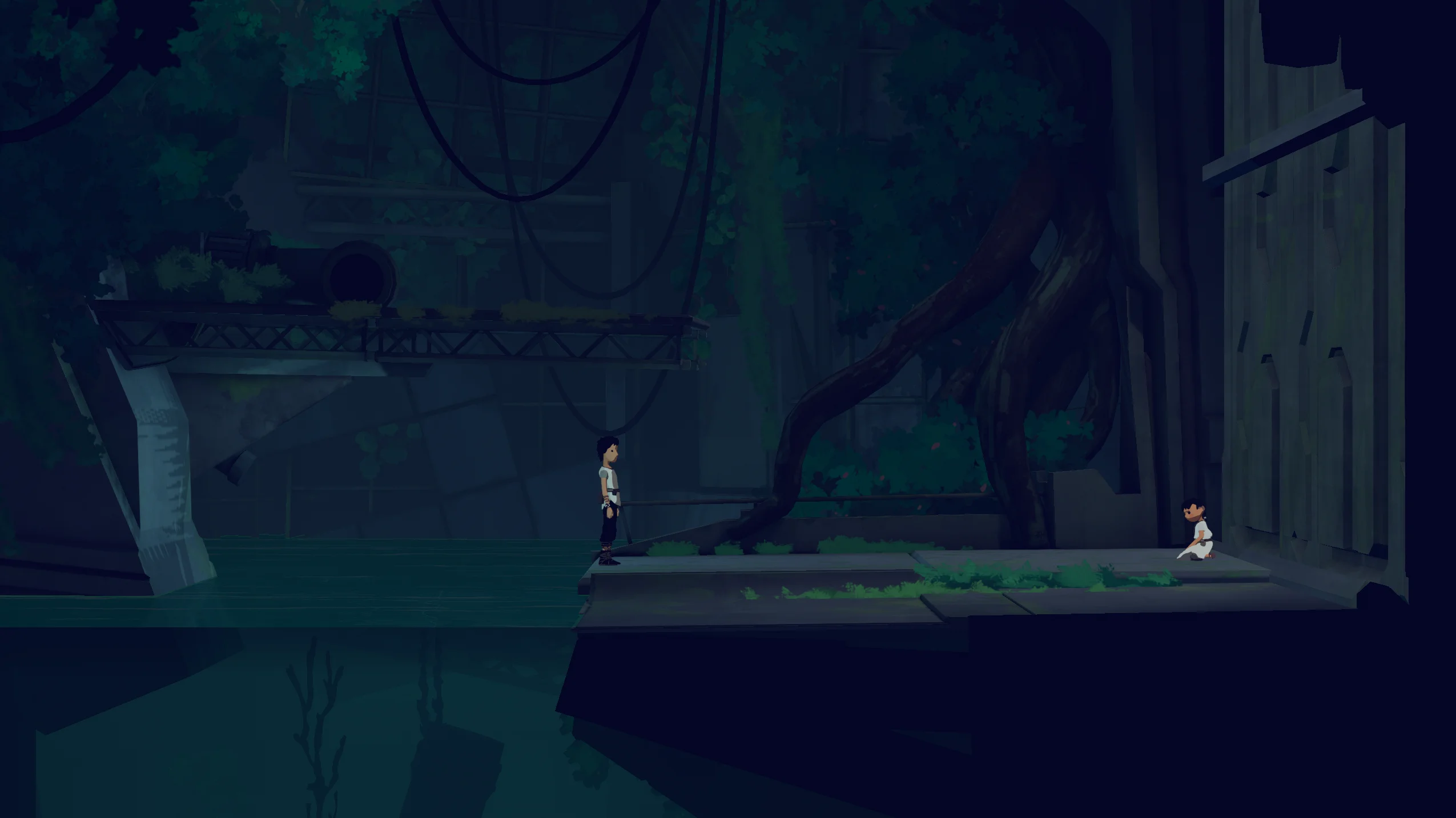
There is a moment, early in Planet of Lana, where you walk through a ruined structure overgrown with enormous roots, and the camera holds a wide shot just long enough for you to stop and think: someone spent a very long time on this.
Not long like "we had a big team and a deadline." Long like "we couldn't stop ourselves."
The Colour Does the Work
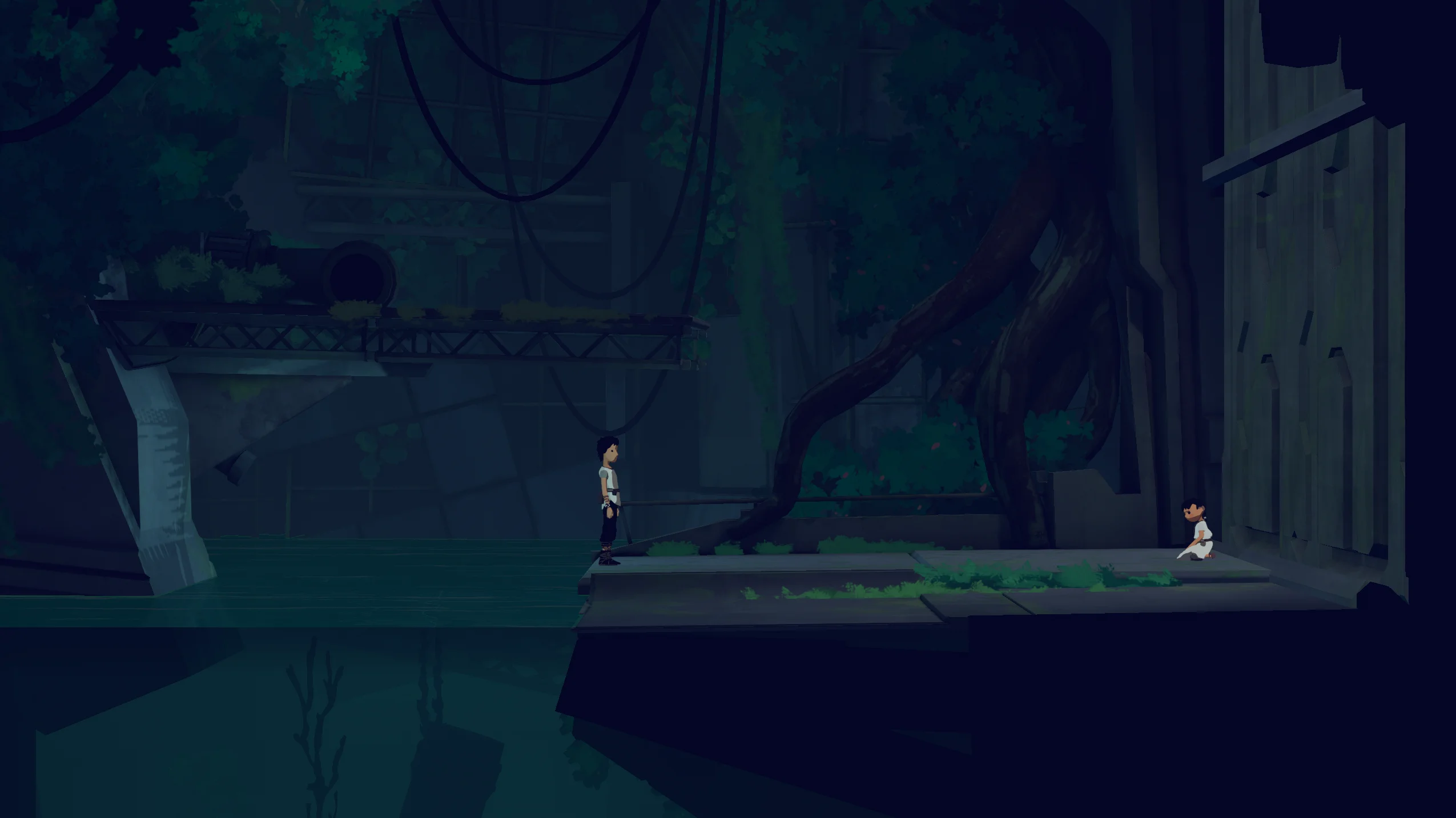
Most games use outlines. Planet of Lana doesn't, really. Shapes are defined almost entirely by colour gradients — deep teal backgrounds bleeding into slightly less deep teal midgrounds, with small figures rendered in warm contrast against the cold. It shouldn't work as well as it does.
The palette is relentlessly cool — blues, teals, muted greens — broken only by small warm details: a lantern, an amber glow, the protagonist Lana's pale jacket. The effect is that every source of warmth feels intentional, like the world is cold and the characters are the only heat in it.
It's a trick borrowed from film, and it's deployed here with the confidence of people who have looked at a lot of cinema and understood why it works.
Someone Has Watched a Lot of Ghibli
The comparisons to Studio Ghibli are inevitable and also correct. The overgrown ruins, the sense of a world that existed long before you arrived and will exist long after, the way nature is always slightly winning — it's all there. Princess Mononoke. Nausicaä. Possibly some Ico. Definitely some classic 80s science fiction illustration in the design of the machines.
What's interesting is that it doesn't feel derivative. The references are digested rather than copied. The world has its own internal logic — an unnamed planet, a peaceful civilisation, machines that arrive one day and simply start taking people. No explanation offered. None expected.
The story is about Lana looking for her sister. That's it. It earns the simplicity.
The Numbers
Planet of Lana started as a two-person project. Joel Lannergård and Isak Martinsson, at Wishfully Studios, originally conceived it as an animated film. They turned it into a game instead. The team grew — but not by much.
The music is by Takeshi Furukawa, who also scored The Last Guardian. It shows. Both games understand that silence is part of the soundtrack.
The game takes about four hours to complete. Some people find this disappointing. Those people are wrong, in the same way that a perfect short story is not worse than a mediocre novel just because it's shorter.
The Machine Against the Organic
The visual language of the invading machines is deliberate: angular, grey, industrial, indifferent. They contrast against everything else in the game — the roots, the moss, the curved lines of the architecture — like a wrong note held just long enough to make you uncomfortable.
The design draws from Moebius-era science fiction illustration: functional-looking mechanisms with no unnecessary decoration, no faces, no concession to approachability. They are not evil. They are simply operating. That's worse.
I don't know what the budget was. I suspect it was not large. I know that it doesn't matter, because every frame of Planet of Lana looks like someone sat with it until it was right.
That is rarer than it should be, and worth noticing when it happens.