
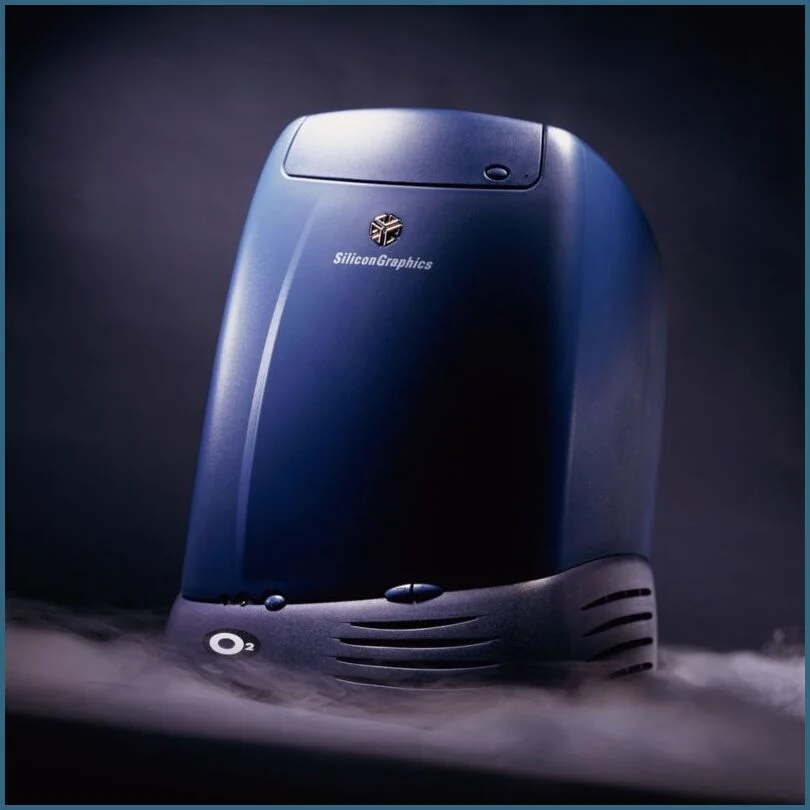
The original
The Silicon Graphics O2 was released in 1996, targeting designers, engineers, media artists, and researchers. It ran IRIX — SGI’s Unix variant — and was a mid-range workstation that punched well above its weight for the 1990s.
What made it genuinely unusual was its memory architecture. The O2 used UMA — Unified Memory Architecture — not just for system memory but for the graphics pipeline as well. The GPU had no dedicated framebuffer; instead it worked directly from shared memory. Passing data between the CPU and graphics was as simple as passing a memory address. Elegant, and decades ahead of where the rest of the industry would eventually land.
The case matched the ambition of what was inside it. Curved, purposeful, immediately recognisable. The kind of industrial design that ages into an icon rather than out of one.
The project
This project resurrects the O2 case and brings it into the modern era. The goal is not a replica — it is a redesign. The original proportions and character are preserved, but the internals are reworked from scratch to accommodate contemporary hardware: mATX motherboards, small-form-factor GPUs, modern I/O, modern cooling.
The intention is practical as much as aesthetic. A case worth living with on a desk, built to house every machine I use — not a showpiece, a daily driver.
- Reverse engineering — dimensioning and documenting the original SGI O2 case geometry as a foundation for the redesign.
- Structural redesign — reworking internal geometry to fit mATX motherboards, modern GPUs, and contemporary cooling solutions.
- Manufacturing — exploring fabrication processes: materials, tolerances, and production methods for a real, buildable case.
Status
Active development. Current work spans reverse engineering the original geometry, CAD modelling in Blender, technical drawings, and manufacturing research.