Yahoo Inc · Augmented Reality · WebAR · 2020–2022
100 million views.
One AR platform.
COMPOSER was Yahoo's web-based AR platform — a tool that let anyone create augmented reality experiences for advertising without writing a line of code. I built the pipeline that made it actually work: CAD conversion, real-time shading, lighting, physics, and a Houdini asset pipeline that turned manufacturer data into something a phone camera could handle.
The platform
The premise of COMPOSER was straightforward and, at the time, genuinely ambitious: democratise AR. Give brand teams, agencies, and retailers the ability to create web-based AR experiences — no app, no SDK, no developer required. Upload your model, configure the experience, publish. Done.
At its peak, the platform was generating over 100 million views and running campaigns for major US retailers. The tech worked. The experiences were fast, accurate, and ran in-browser on consumer hardware. This was not straightforward.
My role was to build and own the technical pipeline that connected raw manufacturer assets to a real-time AR renderer — which is a polite way of saying I spent a considerable amount of time convincing CAD files to behave themselves.
Case study — Ford Mustang Mach-E
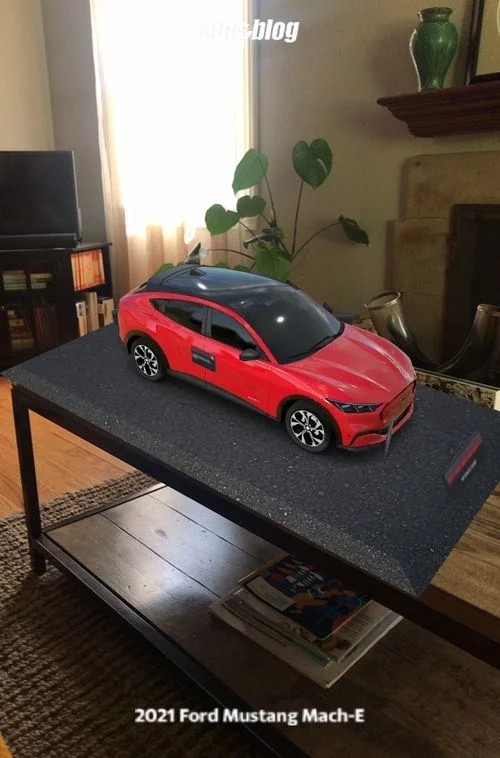
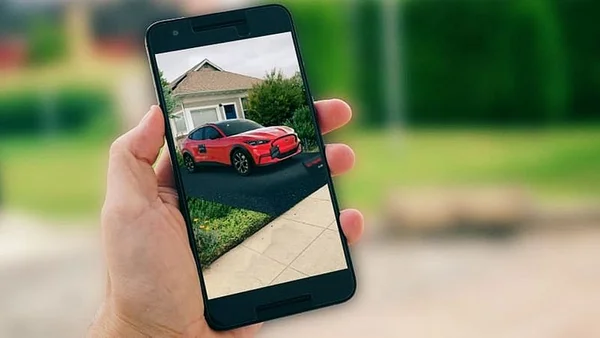
The Ford Mustang Mach-E campaign (2021) was one of the platform's most visible deployments — covered by Autoblog magazine and used to let potential buyers place a full-scale electric Mustang in their driveway before it existed in a showroom near them. This is, objectively, a better way to buy a car than talking to a man named Gary in a car park.
Lighting system
Real-time AR lighting is one of those problems that sounds solved until you actually try to do it on a 2019 mid-range Android. I designed and curated a lighting system that balanced physical accuracy with real-world performance constraints — meaning it had to look correct under a supermarket car park's fluorescents as readily as it did in a Californian driveway at golden hour.
The system used environment-based lighting with a carefully tuned set of probes and fallback configurations, ensuring consistent results across devices and conditions without collapsing into a grey blob.
Car paint shader
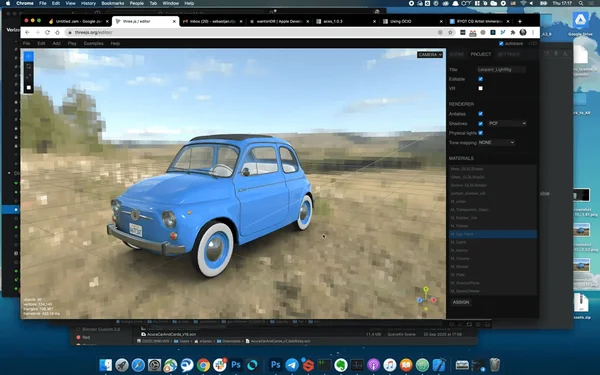
Automotive AR lives or dies by the paint. A car that doesn't look like it's made of metal will not convince anyone to park it in their driveway, even virtually. Standard PBR materials don't capture the metallic flake, the clearcoat refraction, or the colour-shift that makes a car look like a car rather than a plastic toy.
I developed a custom GLSL car paint shader that simulates the layered structure of real automotive paint — base coat, metallic flake, and clearcoat — running in real time on mobile WebGL. The flake layer responds to viewing angle and light direction, producing the characteristic sparkle of metallic automotive paint without destroying the frame budget.
CAD-to-AR pipeline
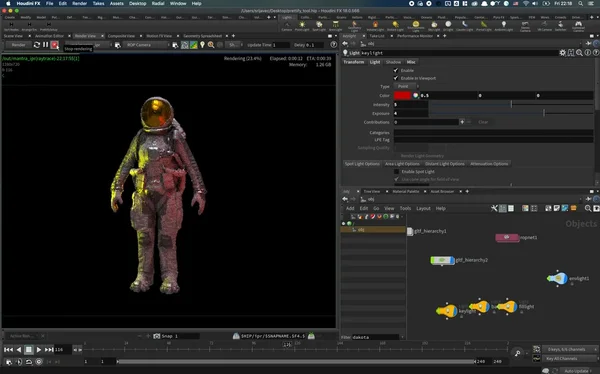
Manufacturer CAD data is not AR-ready. It is, in fact, about as far from AR-ready as it is possible to be while technically still being a 3D file. The polygon counts are astronomical, the topology is optimised for manufacturing simulation, and the materials reference proprietary systems that have no equivalent in a web renderer.
I built a complete Houdini pipeline to convert this data into something a phone could actually render: automated decimation, UV unwrapping, normal map baking, material translation, and LOD generation — all procedural, all reproducible, and all capable of handling the next vehicle model without starting from scratch.
Physics layer
At a later stage of the platform's development, I added a physics layer targeting the automotive sector — interactive features that let users engage with vehicles beyond simple placement and orbit. Doors, bonnets, suspension response, and other mechanical interactions running in real-time within the AR experience.
The challenge was keeping it feeling physical without it feeling slow. AR interactions need to respond immediately — any latency between input and reaction breaks the illusion entirely. The physics layer was tuned accordingly.
Results
100M+ views
Total AR experience views generated across all campaigns on the COMPOSER platform.
Major US retailers
Collaborated with several major US retail brands to deploy product AR experiences at scale.
Press coverage
Ford Mustang Mach-E campaign covered by Autoblog magazine — one of the US's leading automotive publications.